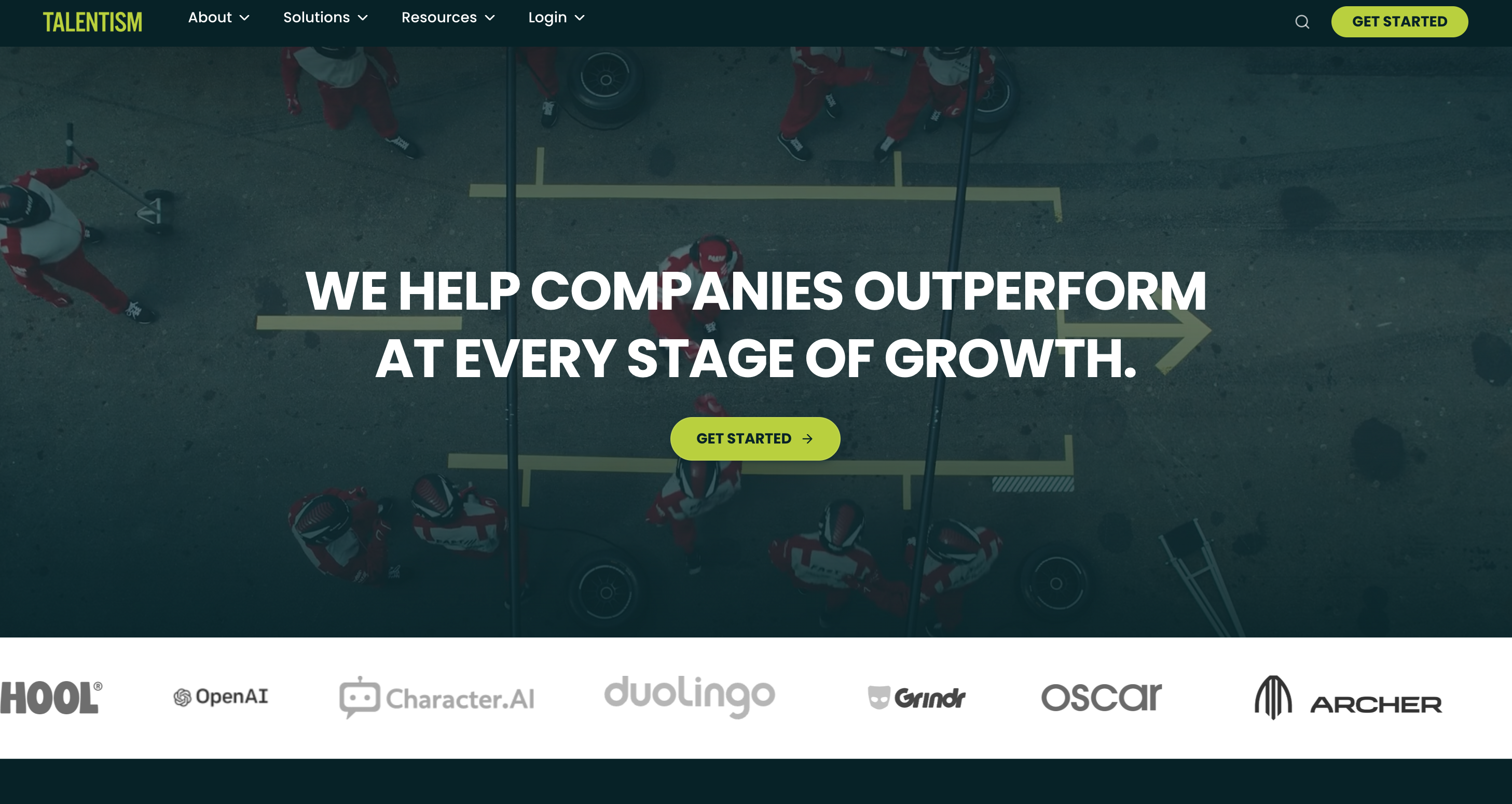
“It's the tool that finally closes the gap between having a clear vision and having it live on the internet.”
A fractional marketing team. A 260-page WordPress site that couldn't keep up with the company. Growth goals that couldn't wait on agency timelines.
Here's how Talentism migrated and improved their website, on-brand and without losing a page of SEO equity.
About Talentism
Talentism is a 13-year-old executive coaching and tech firm that works with rapidly-scaling companies facing the predictable challenges of growth and human friction. As a business grows from Series A through IPO, the strategies that got them to their first milestone stop working for where they need to go. Founder Jeff Hunter and his team work alongside founders, CEOs, and chief people officers to fix the leadership, management, and organizational issues that slow them down.
We met Leigh Garrison, Operating Partner and Executive Coach at Talentism. She joined as a coach, then stepped in as fractional head of marketing to take the lead on improving the company's processes. For her, Job Number One was to improve a website that hadn't kept up with how fast the company was moving.
Talentism is about 20 people today, but the scope has grown significantly. What started as a coaching business now spans four business units: executive coaching, consulting, learning and development, and Sage, their AI leadership advisor. The site serves three distinct audiences: founders and CEOs, chief people officers, and senior leaders. They needed to speak credibly to all of their audiences without losing consistency.
The challenge
A website that had stopped keeping up with the company
Talentism's website was over four-plus years old, running on WordPress, with over 260 pages and years of search equity built. It had passed through multiple marketing stakeholders and agency engagements over the years. But with a small team and limited time, the website stopped keeping up.
Themes had to be actively maintained, every change took too long to execute, and the site had accumulated a graveyard of plugins nobody knew were still running (some sending regular bills). WordPress gave them granular control on paper, but it wasn't built for a non-designer to work in independently. Nate, their fractional creative director, had started building landing pages in Wix just to avoid the friction.
“The gap between having the vision and getting it live was too wide,” Leigh said. “Any solution that solved the new content problem but forced us to rebuild everything from scratch was a non-starter given how much SEO value we'd built up.”
Every AI site builder they tried got them 80% of the way there
Leigh stepped in alongside Nate to take on the migration. She had 20 hours a week for marketing, and the website was just one item on that list. Nate was also working across other initiatives beyond marketing.
Both marketers needed to move fast. They evaluated a range of AI-powered site builders before landing on Kite.
Lovable got them far, fast. The problem was everything after. “You'd spend three hours trying to fix something minor,” Leigh said. “You'd say, ‘I just want to move this here,’ and the AI would change something else instead. It got you really fast, then you gave those hours back.”
The blocker wasn't generating new content. It was preserving 260 pages of search equity while modernizing the design. That's a different problem entirely, and none of the tools they tested were solving it.
The solution
260 pages migrated, SEO-intact, in under a day
Then they tried Kite, and the result surprised even them. “When we got the core architecture right and it took less than a day to batch migrate the existing pages into the new design, that was the ‘Yes, this is exactly what we needed’ moment,” Leigh said.
Through chatting with Kite, the team built out Talentism's full new web presence: a positioning-forward homepage and modules for each of the four business units, including a dedicated page for Sage, their AI leadership advisor. Getting that page right was its own challenge. Sage is a product aimed at senior executives, and the web presence needed to carry that weight without breaking from the rest of the site's design.
The design system also had to work across all of Talentism's audiences.
- Founders and CEOs needed proof that Talentism understands the stakes at Series B–pre‑IPO, and confidence that coaching would translate into measurable business outcomes.
- Chief People Officers needed credibility that Talentism is a partner for org-wide leadership systems, clarity on how the programs roll out across teams, and evidence their services will move retention, performance, and leadership quality.
- Senior leaders needed confidence that the experience of using Talentism is discreet and personalized, that it's applicable to their day-to-day challenges, and proof that Talentism's coaches go beyond traditional coaching to help deliver business results.
Each of these visitors would land on the same site, and the site needed to feel right for all of them.
“The feedback we got was that the output looks like us,” Leigh said. “Which is harder to achieve than it sounds, given that we have complex services, an AI tech product, and we're serving three distinct ICPs.”
It wasn't just the look that mattered. The timing did too. “Getting a polished, on-brand web presence moving in parallel with our positioning work, not sequentially after it, is a real unlock for a small team,” Leigh said.
The Kite team treated Talentism like partners, not one more subscriber
There was a lot that Kite got right technically. But the first thing Leigh brought up wasn't any of that. It was the relationship.
“Over my 25-plus-year career leading full-stack marketing teams, I've never had a better experience than working with the Kite team,” she said. “With most AI solutions, we would have just been a subscriber with no input into where the product was going.”
Leigh and Nate needed brand guardrails: colors, fonts, and design patterns that would hold across pages, so a non-designer could build something new and have it look like the rest of the site. Kite made that possible.
“We could put an example page in and say, ‘Can you build me something like this? Here's all the information I want. Please put it in our design,’” Leigh said. “Nobody else had that.” And nobody else had a real answer to the migration problem.
Marketing velocity, decoupled from developer availability
Leigh and Nate plan to extend Kite to the Sales and Business Development teams, so they can generate sales collateral that automatically stays in line with the site design. Kite keeps that consistency in place by applying the same brand system (colors, typography, layout patterns, and component rules) every time it generates or updates a page. New collateral is always on-brand by default, and no one has to manually police it.
“Marketing velocity stays decoupled from developer availability,” Leigh said. “For a team our size, that's a genuine competitive advantage.”
Your site is falling behind and you don't have the bandwidth (or the appetite) to start from scratch. Book a call to see how fast Kite moves.